
-2.png?width=450&height=450&name=Round%20Blog%20Thumbnail%20(6)-2.png)
Manufacturers are under pressure to do more with fewer resources. As products and distribution networks expand, customers expect faster, clearer support. At the same time, rising labor costs make adding headcount difficult.
This is where technology becomes a lever rather than an expense. When voice, data, and workflows are connected, support teams can handle more work without adding people. The combination of Aircall and HubSpot offers manufacturers a way to scale the impact of their support teams instead of scaling payroll.
This article explains how that works in practice. You will see why manufacturing support teams hit capacity limits, how Aircall and HubSpot act as a force multiplier, and what this setup looks like inside real manufacturing support operations.
Why Manufacturing Support Teams Hit a Breaking Point

Manufacturing support environments are complex. Calls do not come from one type of customer. They come from distributors, resellers, field technicians, procurement teams, and end users. Each group has different needs and different expectations.
Service Demand Grows Faster than Support Teams
As manufacturers grow, support demand often increases even when sales remain steady. New products introduce new questions. More distributors require more coordination. Service contracts and warranties add ongoing obligations that do not disappear after the sale.
This growth rarely happens in a straight line. A product launch can trigger a wave of questions. A supply chain disruption can drive an increase in inbound calls overnight. Seasonal demand can push teams beyond capacity with little warning.
Research shows that 61% of customer support leaders report increased call volumes since 2020, indicating a sustained rise in service demand rather than a temporary spike. These surges expose the limits of teams that rely on manual processes to keep up.
Hiring is Slow, Expensive, and Hard to Justify
Hiring more agents sounds simple, but it rarely is. Each new hire adds salary, benefits, onboarding time, and training costs. For manufacturers, support knowledge is often specialized. New agents need time to understand products, part numbers, service workflows, and distributor relationships.
Even after hiring, productivity does not increase immediately. Senior agents must pause their own work to train new team members. This often results in a short-term dip in service quality before improvements are visible.
Leadership teams hesitate to approve headcount increases when demand fluctuates. Payroll is a fixed cost. Service demand is not.
The Real Bottleneck is Manual Work, not Call Volume
When support teams take a closer look at how work actually gets done, call volume is rarely the main problem. The bigger issue is everything that happens around the call. Time is lost before the conversation even starts and again after it ends. Agents search for customer details across systems. For example:
- They log calls by hand.
- They write long notes to capture context.
- They try to remember who needs a follow-up later.
Over the course of a day, these small tasks add up. They slow agents down and drain energy that could be spent helping customers. Managers feel the impact too. It becomes hard to see which calls lead to real resolution and which ones create more work later.
This is the point where tools start to matter. Teams need systems that remove manual work, connect calls to real outcomes, and surface the context agents need without extra effort. That is where Aircall and HubSpot make the difference.
How Aircall and HubSpot Act as a Force Multiplier for Lean Teams
One Shared System for Calls, Tickets, and Customer History
When Aircall is integrated with HubSpot, every call is automatically added to the customer record. Incoming and outgoing calls log directly to contacts, companies, and tickets. Agents do not need to copy details or switch tabs to identify the caller.
Before answering, agents review the caller's identity, purchase history, prior issues, and open tickets. This changes how conversations begin. Agents move straight into problem-solving instead of discovery.
For manufacturers, this context matters. Calls often reference specific orders, parts, or service events. Providing that information instantly reduces call time and frustration for both parties.
Real-time Sync Removes Duplicate Work
Data sync between Aircall and HubSpot works in both directions. When contact details are updated in one system, they are updated in the other. Agents do not correct phone numbers twice or reconcile mismatched records later.
This removes a common source of hidden work. Small tasks repeated hundreds of times add up. Eliminating them frees hours every week without changing headcount.
Automation Replaces Memory-based Processes
Many support processes rely on agent memory. Remember to create a ticket after the call. Remember to follow up tomorrow. Remember to notify another team.
With Aircall and HubSpot, calls automatically trigger actions. A call can create a ticket. A call outcome can assign a follow-up task. A missed call can notify the right team.
This reduces the risk of dropped issues and improves consistency across the team. Automation becomes the safety net that allows teams to scale confidently.
For more info on how Aircall and HubSpot can help manufacturers, see this post.
3 Key Capabilities That Turn Integration Into Output
The integration creates the foundation. These are the specific capabilities that turn that foundation into measurable output gains for support teams.
1. AI-generated Call Summaries Eliminate Manual Note-taking
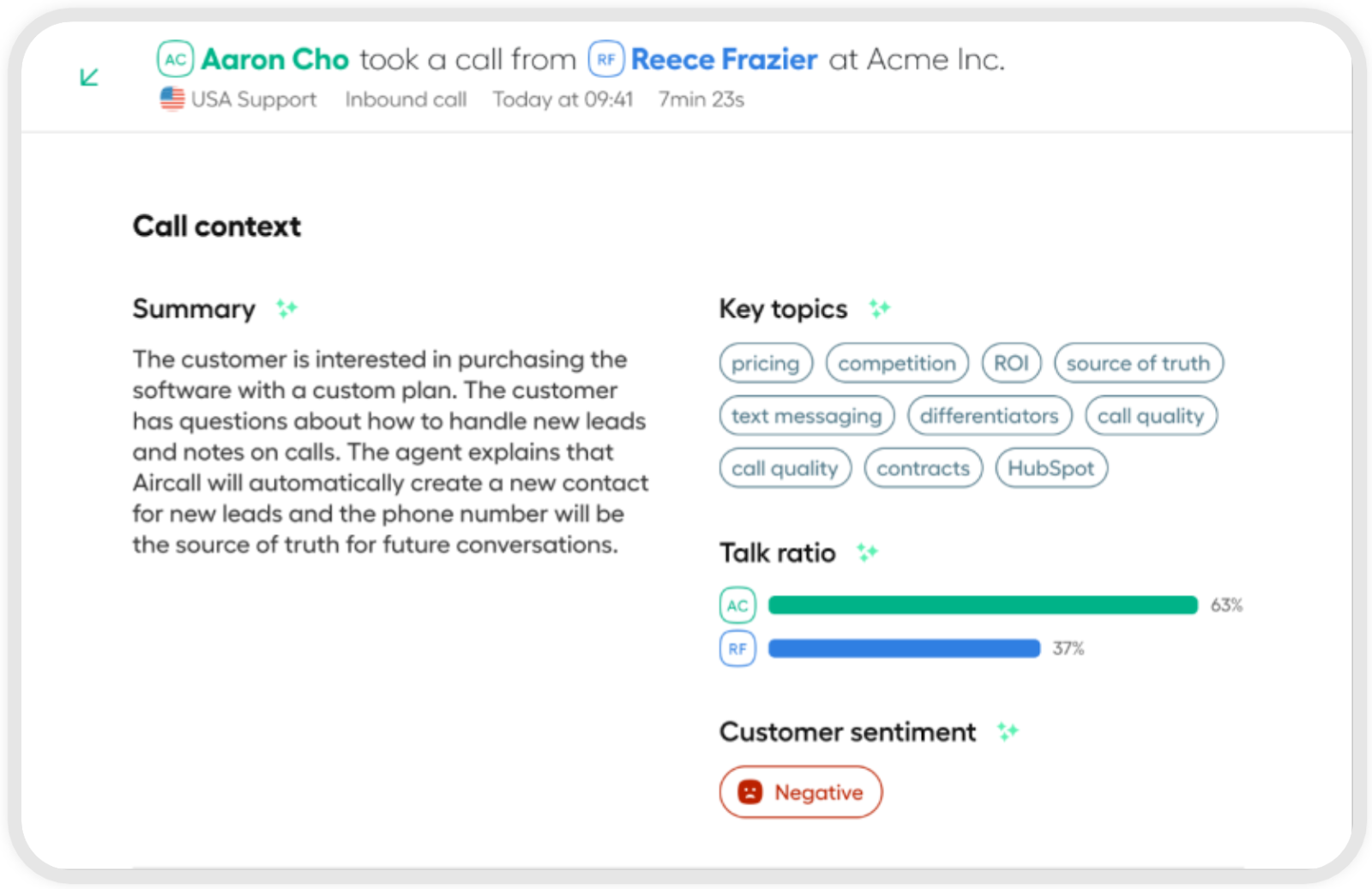
After a call ends, agents typically take notes. They summarize the issue, document next steps, and capture context for future reference. This work is necessary but also repetitive and time-consuming.
Aircall uses AI to automatically generate call summaries. These summaries capture the key points of the conversation and attach them to the HubSpot record. Agents review rather than write from scratch.
This saves time and improves consistency. Summaries follow the same structure regardless of who took the call. When shifts change, the next agent understands what happened without having to decipher personal note styles.
Over a full day of calls, the time saved compounds. Agents end shifts with less backlog and more energy.
2. Integrated Reporting Connects Call Volume to Outcomes
Manufacturing leaders often see call volume reports without understanding the impact. How many calls led to resolved issues? How many created follow-ups? How many required escalations?
With Aircall and HubSpot, reporting connects activity to outcomes. Managers can see how many calls result in tickets. They can track resolution rates. They can identify which issues consume the most time.
This visibility enables smarter decisions. Instead of guessing where to improve, teams focus on the calls that matter most. Productivity improves without expanding staff.
3. Automated Ticket Routing and Follow-ups Keep Work Moving
Manual routing slows teams down more than it seems. After a call ends, an agent must decide where to route the issue and what steps to take next. During busy periods, those small decisions pile up and create delays.
With automation in place, that friction disappears. Tickets are routed automatically based on factors such as the issue type, urgency, and the customer’s status. The right team gets the work right away, without waiting for someone to pass it along.
Follow-ups also happen automatically. Agents no longer have to remember who to contact or when to follow up. Customers get responses on time, and internal teams stay in sync. That steady flow makes it much easier to handle higher volumes without things breaking down.
Where Manufacturers See the Biggest ROI From This Setup

Return on investment shows up in places manufacturers care about most. Support becomes faster. Costs stay controlled. Customer experience improves in ways that affect revenue, not just internal metrics.
More Issues Resolved Without Extending the Workday
Support teams gain capacity by removing friction from everyday work. Less time goes into searching for information or documenting calls. More time goes into solving problems and closing issues properly.
As resolution improves, customer confidence increases. This matters because research shows that 75% of customers are willing to spend more with brands that deliver a good customer experience. Faster and more informed support directly supports that outcome without requiring longer shifts or more staff.
Support Costs Flatten Even as Demand Grows
Manufacturers often expect support costs to rise as service demand increases. This setup changes that pattern. The same team handles more work, which lowers the cost per interaction and reduces reliance on temporary staffing during peak periods.
Training costs also stay more predictable. Clear workflows and shared context reduce rework and prevent issues from being reopened. Savings come not only from payroll control but from fewer wasted hours across the team.
Fewer Repeat Calls and Fewer Escalations
Repeat calls usually indicate that something was missed the first time. Lost context, incomplete follow-ups, or unclear ownership all lead to extra work and frustrated customers.
With calls, summaries, and tickets connected in one system, agents see the full picture before responding. Issues are closed more completely, which reduces repeat contact and escalation.
Over time, support feels more reliable and more valuable to customers, which strengthens long-term relationships rather than just resolving individual issues.
For manufacturers trying to scale support without scaling payroll, the combination of HubSpot and Aircall offers a practical path forward that aligns cost control, productivity, and service quality in one decision.
Scale Support Without Expanding Payroll!
Manufacturers do not have to trade service quality for cost control. Support can scale without adding headcount when the right systems are working together.
By connecting Aircall and HubSpot, teams reduce friction across every interaction. The result is a support operation that keeps pace with the business, even as demand grows, without locking in higher payroll costs.
If you want a clear and practical guide on how this setup can fit your manufacturing workflows, we can help map the right processes, tools, and integrations to your goals.
Talk to Origin 63 today and start improving how your team understands and manages every customer relationship.











.png?width=90&height=90&name=Arrows%20Partner%20Badge-test%20(1).png)